What are the aesthetic causes of breast growth?
Many women desire fuller breasts either because they are naturally too small or because they subjectively feel their breasts are too small. A change in breast shape following pregnancy or extreme weight loss, or due to the natural aging process, can also be a determining factor in wanting a breast augmentation.
What are the medical causes of breast enlargement?
Medical indications such as congenital or acquired deformities, deformities, congenital deformities or asymmetries also play an important role in the decision for breast augmentation. If one or both breasts need to be completely removed due to cancer, breast augmentation can contribute to a more positive attitude towards life.
In addition to the effect of well-shaped breasts, the operation gives many women a new self-confidence and a new sense of well-being in their bodies. This can eliminate many psychological problems by ensuring that women are no longer subject to any mocking or derogatory comments. With new breasts, inferiority feelings and problems with sexuality can also be reduced. However, due to medical reasons such as expected posture problems, the desire for large breasts in particular needs to be adjusted.
Who is breast augmentation suitable for and who is it not suitable for?
It is important for the doctor to discuss the psychological reasons for breast enlargement in advance to ensure that the woman does not want to undergo surgery due to external pressure. It is equally important for the treating doctor to ensure that the change request is realistic and that the new breasts are in proportion to the woman’s other body proportions.
Who is considered a risk patient for breast enlargement?
In some cases, the operation may not be performed if there is pregnancy or allergy to the materials or medications used. Even serious diseases such as autoimmune diseases lead to a high risk of complications, so breast augmentation should be avoided in some cases. If you cannot tolerate general anesthesia, have an acute infection, or have unclear breast findings, you should not undergo surgery, otherwise your doctor will recommend a preliminary examination.
At what age is breast augmentation allowed?
Basically, breast augmentation is suitable for all women aged 18 and over. There is no upper age limit as long as the general health condition allows the operation and implant placement under general anesthesia. However, since the elasticity of the connective tissue decreases with age, this situation must be taken into account for the final result.
Is breast augmentation suitable for women with sagging breasts?
Breast augmentation is only partially suitable for women with sagging breasts. The desired idea may not always come true because if the woman has sagging, drooping breasts, they cannot be brought into an upright, erect position with implants. Even a pointed breast or any breast shape that you do not like may not always be brought into the desired shape during breast surgery. A preliminary interview with the treating doctor provides clarity about the expected result and the augmentation options or the need for tightening.
What implants are available for breast augmentation?
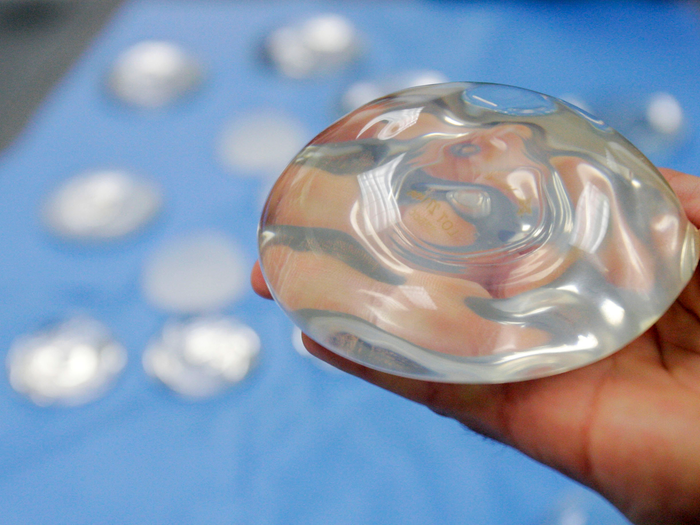
Breast implants come in different shapes, sizes, textures, structures and (filler) materials, so you should learn more about each option beforehand. Different implants can be used depending on the desired breast size. Other implant size factors include the patient’s skin condition, chest width and available breast volume.,
What does adhesive mean in connection with breast implants?
The gel contained in implants is sticky, meaning it is solid. If the silicone pad breaks due to certain reasons, such as a serious accident, the material cannot spread into your body due to its strength.
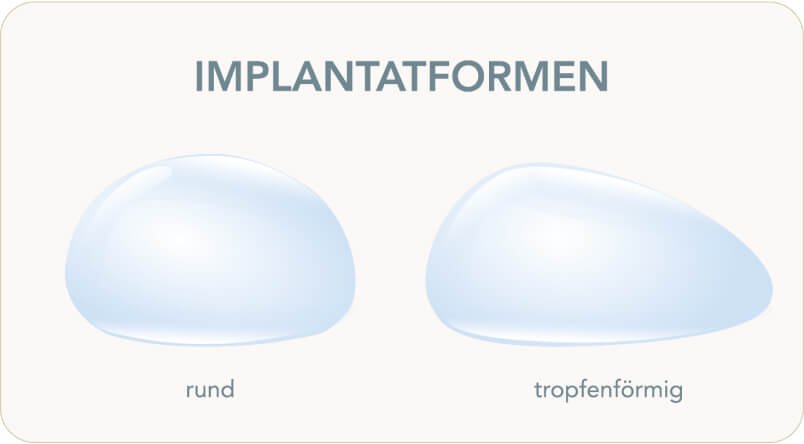
Round implants
Round implants have a central curvature, so they make the décolleté appear noticeably fuller. When viewed from the side, your breasts will appear more voluminous.
Anatomical or teardrop-shaped implants
This type of implant is based on the natural shape of the breast, with the focal point being in the lower breast area.
What happens before breast surgery?
Before every operation, a comprehensive consultation with the plastic surgeon and later with the anesthetist is necessary. During this consultation, you can present your wishes and ideas to the doctor again. Together, you will consider what shape, size and quality your implants should have. The doctor will advise you on which implants are best for your body. He will also talk to you about the procedure, different surgical techniques, possible risks and complications. He will also clarify in preliminary examinations which implant size is actually suitable for you, as this is limited by the properties of the existing breast tissue. The end result should be a beautifully shaped breast that fits your body proportions well. Finally, personal concerns and questions about necessary pre- and post-treatment are addressed
What examinations must be done before breast surgery?
Sometimes your doctor may decide during the consultation that further imaging tests are necessary. These provide information about your physical health. This will help the doctor decide whether breast enlargement is possible for you or not.
- Mammography
The examination usually only takes a few minutes. The breasts are clamped between two plates and briefly pressed together. Two X-rays are taken of each breast, which the doctor can use to identify any cancer or precancerous lesions.
- Ultrasound examination
During an ultrasound examination , the doctor will scan your breasts for about 20-30 minutes with the ultrasound device and examine them for possible pathological changes in the glandular and connective tissue. A finding could make breast enlargement impossible for the time being
What should I consider before cosmetic surgery?
Before the procedure, you should check with your anesthetist which medications you regularly take are permitted for the operation. You should stop taking blood-thinning medications about five to seven days before the surgical procedure. These include aspirin, ASS, Plavix or Marcoumar. You should also stop taking sleeping pills two weeks before the procedure. Due to the negative effect on wound healing and blood circulation, you should only consume nicotine and alcohol in small amounts or, ideally, not at all. It is also advisable to refrain from smoking after breast enlargement, as this can delay wound healing. You should not eat anything for six hours before the procedure, and you can still drink water and unsweetened tea up to two hours before.
How does breast enlargement work?

Breast augmentation is usually performed on an outpatient basis without hospitalization or as an inpatient hospital stay of one to three days . The surgical procedure itself takes approximately 60 to 90 minutes .
What type of anesthesia is possible for breast surgery?
In principle, we differentiate between twilight sleep, deep sedation and general anesthesia. Depending on the technique and requirements, a variant is chosen that is individually tailored to you.
Is breast enlargement also possible under local anesthesia?
In principle, local anesthesia is possible for breast augmentation, but it is not recommended. Too many injections would be necessary and you would feel a lot of the operation, which could be stressful for you. Local anesthesia combined with twilight sleep is also possible. However, since general anesthesia has become so safe these days, the question arises as to why not just choose a short general anesthesia with potentially less risk. Your doctor will take enough time to talk to you about the advantages and disadvantages of the individual types of anesthesia.
How is the implant inserted?
Depending on the patient’s breast and body shape, there are three ways the surgeon can insert the implants into your breast:
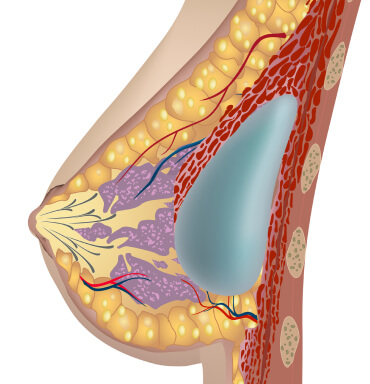
Submuscular
With this method, the implants are pushed under the large pectoral muscle. This procedure has proven to be particularly effective in patients with little glandular tissue, as the cushion would otherwise be highly likely to be visible and clearly palpable under the skin. This method also reduces the risk of capsular fibrosis . If the mammary gland sinks over the years, this can lead to a deformation of the breast, which is known as waterfall deformity.
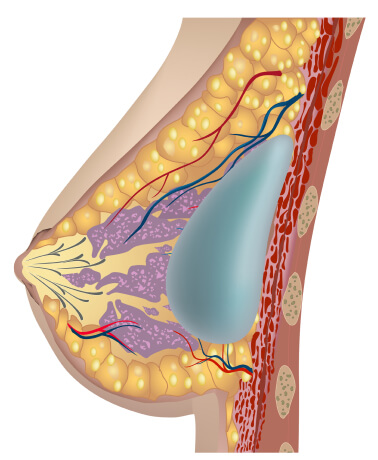
Subglandular
If you have enough firm glandular tissue, the doctor can also place the implants under your glandular tissue above the pectoral muscle. This method can be performed at the same time as a breast lift or a correction of the so-called tubular breast . If the implant sinks below the inframammary fold because it is not held in place by the pectoral muscle, the phenomenon of “bottoming out” can occur.
Dual plane or double layer technique
A combination of both techniques has been used more and more in recent years. The surgeon places the implants mostly under the large pectoral muscle. Only the lower third is covered by the mammary gland and fatty tissue, which gives the breast a natural appearance and is relatively non-slip. At the same time, the nipple can be rotated a little, so that even slightly sagging breasts can be operated on safely and naturally using this technique.
What cutting techniques are available for breast augmentation
The doctor can choose between three variants of the cutting technique:
Inframammary access
With this technique, the surgeon makes a three to four centimeter long incision directly under the breast in the inframammary fold. In medicine, this area is called the submammary area and the fold is called the submammary fold. The disadvantage of this method is the small, permanent scar, which can be seen when lying down.
Transaxillary access
The second access is via the armpit, medically known as the axillary, with the incision being made directly in the crease of the armpit. The surgeon then inserts a mini camera into this incision, which he can use to determine the right place for the implant. The surgeon then places the cushion under or over the pectoral muscle. With this method, scars are only visible if you raise your arms, but there is a higher risk of infection, as bacteria can collect more easily in the armpit. This incision technique is also more suitable for smaller implants, as the place where they are to be located is far away from the incision and therefore difficult to see.
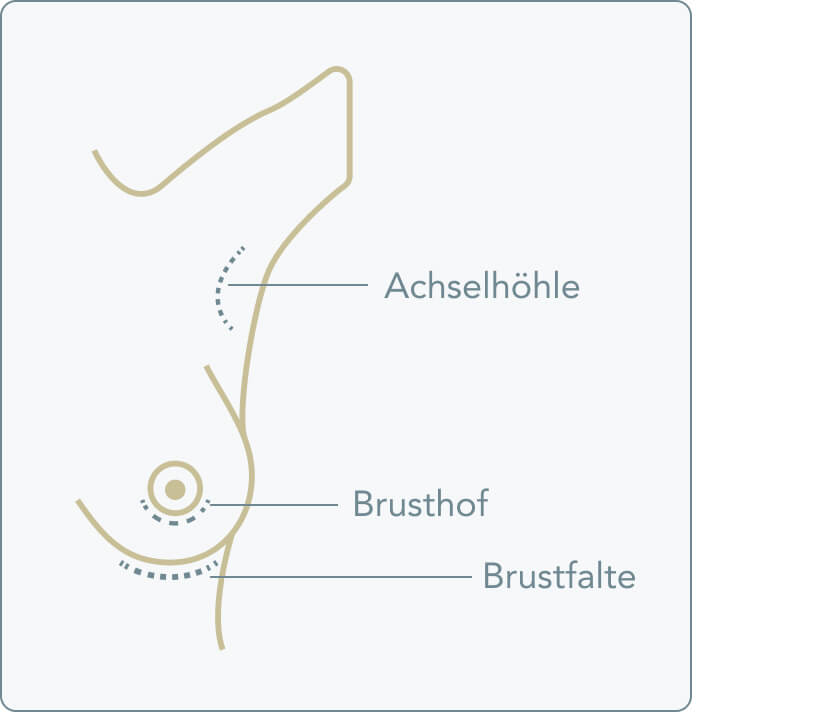
Periareolar access
The third access is via the nipple, i.e. periareolar or transaureolar. The doctor inserts the implant into a prepared pocket through a crescent-shaped or round incision around the areola. Since the incision is made on the edge of the areola, hardly any scars are visible after the operation. However, the access is relatively narrow and the doctor has to cut through breast gland tissue.
Is there breast enlargement with your own fat?
In principle, you can also have your breasts enlarged using your own fat , but this method often does not produce the desired results. You should also have enough of your own fat to be available to the surgeon during the operation. Most of the time, the fat deposits on the stomach, buttocks or thigh region are tapped.
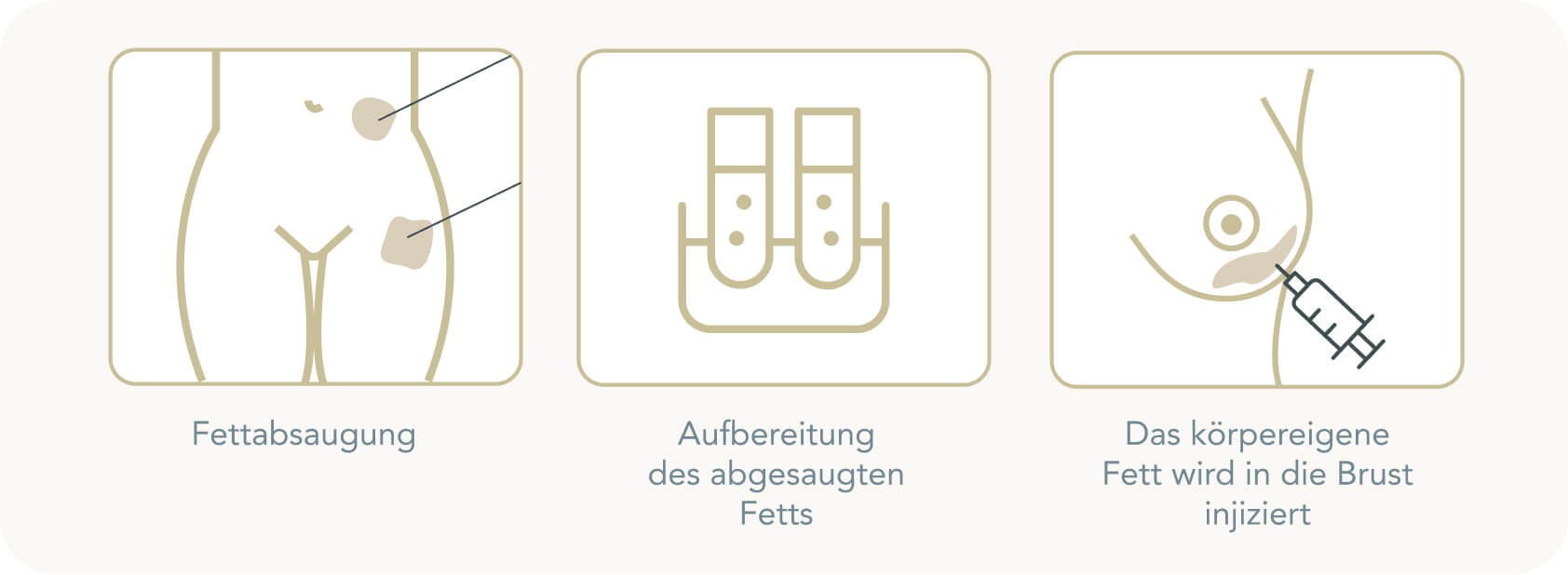
How does breast enlargement with your own fat work?
The surgeon takes fat from your deposits and prepares it for the procedure. He then injects this prepared fatty tissue under the mammary gland. There, about two-thirds of it grows in and thus enlarges your breasts.
What are the advantages and disadvantages of breast enlargement with fat compared to implants?
In comparison to implants, it is usually not possible to create a standing breast from your own fat ; instead, it tends to sag. In addition, only one cup size can be achieved per procedure with this method. If you want more volume, you must expect a second operation. In most cases, the shape created does not correspond to the patient’s wishes. In addition, the body can break down fat after the operation and thus reduce the volume of your breasts again. Studies have also shown that there is a risk of damage to the mammary glands from your own fat. The risk of breast cancer is also said to be increased with this method.
The advantages are the faster recovery phase, during which no stitches need to be removed. The procedure does not necessarily require general anesthesia and can be performed on an outpatient basis and takes one to three hours. You can also go about your normal daily life again after two weeks and do sports after about six weeks. In addition, the body’s own tissue is well tolerated. However, patients who are intolerant to implants in particular benefit from this method. Small asymmetries can be easily corrected and a moderate volume gain can also be achieved.
Is there breast enlargement without surgery?
There are a few less successful methods available for breast enlargement without surgery. With most of these methods, the enlargement procedure must be repeated regularly, as the result is not permanent. The advantages of these methods are that you can see the result immediately, there are no scars, and no operation requiring a hospital stay is necessary. The treatment also does not require general anesthesia and is associated with a quick recovery and rest period.
How can breasts be enlarged with fillers?
In breast enlargement with fillers such as Macrolane, a gel based on hyaluronic acid, the substance is injected with a needle directly under the skin into the breast tissue. This can increase the breast size by one cup size. The procedure is usually performed on an outpatient basis under local anesthesia and the result is immediately visible. Macrolane has come under a lot of criticism and is rarely used anymore.
Why is breast enlargement using fillers not recommended?
There are several reasons why this method is not recommended. Firstly, the procedure must be repeated every year because the body breaks down the gel within a year. In many cases, however, the filler has not broken down within the specified time, as previously assumed, and has led to increased capsule or nodule formation.
How else can breast enlargement be achieved without surgery?
In addition to breast enlargement with fillers, there are some other trends that claim to be able to enlarge breasts without surgery.

Through special body care products and nutritional supplements
This combination treatment consists of a cream and an ISO-certified capsule with natural ingredients such as B vitamins, biotin, pantothenic acid, vitamin C and niacin. The manufacturer promises a breast enlargement of 1.5 cup sizes in eight weeks. There are also pure cream or nutritional supplement treatments that are supposed to cause visible breast enlargement.

Vacuum pump
When used regularly, a small vacuum pump can lead to a moderate enlargement of the breast, as it promotes blood circulation and thus makes the tissue more voluminous.

Sport
Sport does not help to enlarge the breasts, but it does help to firm them, which makes them appear a little fuller. However, it is important to remember that the size of the breasts is not determined by the pectoral muscles, but by the mammary glands.

Nutrition
When you gain a few kilos, your breasts also gain fat tissue, which makes them larger. However, the fat does not always accumulate on your breasts, but also on other parts of your body.
What risks and complications can occur during breast enlargement?
Every surgical procedure is associated with certain complications, including cosmetic surgery such as breast augmentation. In addition to the classic complications such as the risk of anesthesia, post-operative bleeding and impaired wound healing, there are also special complications. The following complications are distinguished:
What complications can arise from implants?
Possible complications of implants include fracture or capsular fibrosis :
- Implant fracture
A rupture of the implant is indicated by damage to the outer silicone shell. Very small injuries to the shell lead to gel bleeding, also known as silicone bleeding. Large ruptures cause the entire capsule to collapse, which can cause the breast to become deformed after an accident, for example. If there is silicone bleeding, the implants should also be replaced, as small pieces of silicone can otherwise settle in the lymph nodes over time.
If saline solution leaks out, doctors speak of deflation. The implants shrink very quickly due to the loss of fluid and must therefore be replaced.
- Capsular contracture/capsular fibrosis
Doctors understand capsular fibrosis or capsular contracture to be a thin, connective tissue-like capsule that forms around the implant due to an immune reaction in the body. This is initially neither visible nor palpable, but can lead to displacement of the implant. If a severe contracture or fibrosis of the shell occurs, it must be surgically corrected or removed. To prevent capsular fibrosis, you should make sure you use high-quality implants with a texture. Exact placement and a gentle, bloodless surgical procedure as well as the prophylactic intake of antibiotics and wearing a compression support bra can also reduce the risk of this complication.
Possible consequences of breast surgery
Pain As with any operation, pain
can occur after breast augmentation . However, if you feel pain when moving your arms, you should inform a doctor. Postoperative bleeding Postoperative bleeding can also occur repeatedly in the first 24 hours after the procedure. A blood vessel that was cauterized during breast surgery can open up again and bleed into the wound cavity. If the bleeding does not stop on its own, another operation may be necessary to remove the bruise and close the source of the bleeding. Bruise (hematoma) Bruises, medically known as hematomas or bruises, can be caused by blood leaking into the subcutaneous tissue. This initially causes the skin to turn blue. Over the course of the healing process, this spot takes on different colors. To prevent further spread and to relieve pain, you can cool the affected part of the body. Seroma In some cases, wound secretion accumulates in the wound cavity. This is normally broken down by the body itself. Only in rare cases does this need to be done by a doctor. Infection If redness, swelling or overheating of the skin occurs, in most cases it is an infection that should be treated with an antibiotic. Only very rarely does the implant need to be removed for this. Wound healing disorders Wound healing disorders usually only occur in people who are prone to it, such as diabetics. Enlarged lymph nodes Swelling of the surrounding lymph nodes is a harmless phenomenon. This swelling usually disappears on its own and only requires medical attention if it persists after several weeks. Sensory disturbances One in seven women can experience permanent sensory disturbances in the breast and nipple area. For most other women, however, this discomfort disappears after a while. Mondor syndrome (cord-like thrombophlebitis) In medicine, Mondor syndrome is a very rare cord-like, superficial vein inflammation that can occur particularly in the front of the chest. This causes ten to 20 centimetres long hardening along the veins. The reason for this phenomenon is not yet known. You can cool the affected parts of the body. The pain usually disappears within a few weeks.
Breast enlargement – possible consequences
Asymmetry (unequal sides)
If there was asymmetry before the operation, this can still be visible after the procedure, namely if it was not compensated for by implants of different sizes. The different healing processes of the breasts can also lead to temporary asymmetry, which should, however, be compensated for after a few days.
Problematic scarring
In some cases, problematic scarring can occur. The scar becomes deformed, becomes bulging or shifts to another place. This can be prevented by a certain surgical technique. Specific scar therapy with ointments or plasters can have a positive effect on scarring and thus prevent problems.
Implant rotation (twisting of the implant)
If the implant’s growth process does not proceed as intended, a sudden movement, for example during sport, can cause the implant to twist and thus deform the breast. This can happen especially with implants with a smooth surface. Textured implants grow into the tissue more quickly, meaning they twist less often.
Slipping of the implant (bottoming out)
In the case of bottoming out, the implant slips downwards while the body tissue stays at the top, making the lower half of the breast appear very shortened and the nipple pointing upwards.
Double breast/wavy breast (double bubble)
A double bubble gives the impression of a wavy breast. This phenomenon occurs because the implant is out of place. In the worst case, two breast mounds are created, which is known as double breasts.
Wrinkles on the implant (rippling)
The softer the implant, the greater the possibility of wrinkling. This only becomes a problem when it becomes visible or palpable. Rippling can occur, especially in slim women, if the body tissue does not adequately cover the implant.
Stretch marks (striae, stretch marks)
Stretch marks or stretch marks are caused by stretching of the subcutaneous tissue, for example during growth, pregnancy or significant weight gain. These remain visible even with breast enlargement.
Increased vein markings
Breast enlargement can make superficial blood vessels more visible temporarily or permanently.
Stretching of the areola
If the implant is inserted over the areola, it can be slightly enlarged, although this change is usually not noticeable.
Breastfeeding problems
Although breastfeeding is still possible after breast augmentation, a change in nipple sensitivity can lead to breastfeeding problems. Even small inflammations of the milk ducts can cause them to stick together, making breastfeeding difficult or even impossible.
Possible effects on general health
Breast augmentation operations were previously considered a possible trigger for autoimmune diseases. However, this has not been scientifically proven. If you have concerns about whether breast augmentation is an option for you, it is best to discuss this with your doctor.
What should I consider after a breast enlargement?
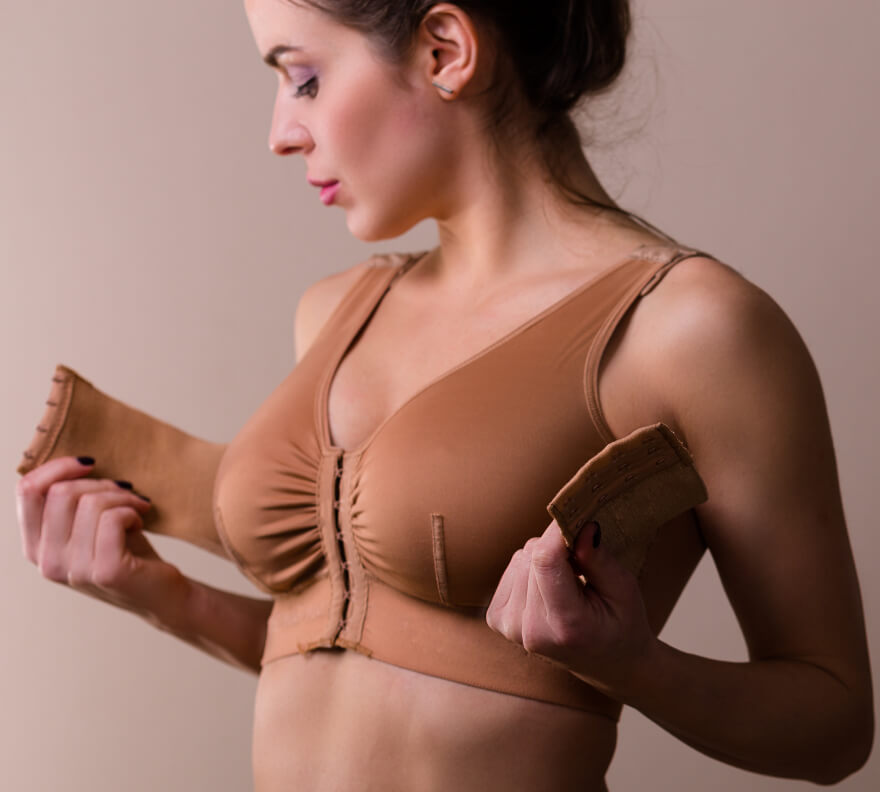
Initially, you should wear a support bra for five to six weeks to prevent the implants from becoming displaced. In addition, wearing an underwire or push-up bra can lead to problems with the healing of the scars. Swelling and sensitivity problems can also occur, but these disappear after days or weeks. The drain is usually removed the day after the procedure.
The doctor will remove non-dissolving stitches after about 14 days. The scar will initially be a little red and will only fade after some time. You can also care for it with a cream, but you should avoid UV light for about six months. In the first two weeks you should keep the surgical site dry, which means that you should not do any strenuous activities that cause you to sweat. You can only shower again once the stitches have been removed. Immediately
after the operation you will also receive an implant pass, which contains all the important information about your implants. You should always carry this with you to make it easier to provide assistance in the event of an accident.
How long do I have to rest after a breast augmentation?
You can go back to work after about seven days, but you should still take it easy physically, avoid lifting heavy objects and do no strenuous housework. You should also be careful with your breasts during sexual intercourse for the next two months. About a month after the procedure, the implant will have healed into your tissue. However, your breasts will be tense for a few months. Only then will they regain their original consistency and sensitivity. To prevent the implants from slipping, you should only sleep on your back or slightly on your side for the first few weeks. Only then can you assume any sleeping position and lie on your stomach again.
How long should I avoid exercise after breast augmentation?
You can start exercising lightly after just a few days, as a walk in the fresh air can have a positive effect on the healing process. Exercise also prevents the formation of thrombosis . You should only slowly start endurance sports again after about four weeks, and strength training after six weeks. In general, it is best to listen to your body and give yourself enough time to regenerate.
How long will I be in pain after breast augmentation?
Normally, your breast will be sore and tense after the operation, but pain therapy is usually started after the surgical procedure so that you do not feel any pain immediately after waking up. In the first few days after the operation, the breast is usually very swollen, which is why you should cool it. The best way to do this is to use a cold pack or a wrap made of curd cheese. The wound will heal for three to six months, and during this time, discomfort is normal for the body.
When can I see the finished result?
You can admire the final result of the breast augmentation approximately three to six weeks after the operation. You should wait a total of three to six months until the scars have completely healed and the swelling has completely gone down.
When does the breast sag after breast augmentation?
The implants usually sink in the first few months, contributing to a natural-looking end result. If you have strong pectoral muscles or very firm tissue, this process can take even longer. In rare cases, the sinking can even take years.
When will the results of breast enlargement be visible?
After two to three months, the result of breast enlargement is visible.
How do the results of breast augmentation with fat transfer differ from those of breast augmentation with implants?
At first the volume of the breast appears somewhat larger than planned after treatment with the patient’s own fat, as more of the patient’s own fat is injected. This is done because the body breaks down some fat cells during the first few months. If the desired size has not been achieved, a second operation is usually necessary. In addition, only an increase of half to a maximum of a whole cup size can be achieved per procedure. The big advantage is the reduced risk of complications and inconspicuous scarring, as the patient’s own fat is injected using a cannula. Implants are more stable in their shape right from the start and can remain in the body for many years. They can be used in different shapes and sizes. The disadvantage, however, is that the edges of the implant can often be seen, which affects the natural appearance of the breasts. In some cases a second operation is even necessary.
Is the result of breast augmentation with implants permanent?
If there are no complications or accidents with implant rupture, breast augmentation with implants generally lasts a lifetime, although some manufacturers recommend having them replaced after about 15 years. Also note that your breast shape changes over the years, so another operation is usually not necessary but is often desired.
Is the result of breast enlargement with fat permanent?
After the body initially breaks down some of the fat cells, the rest remain in the breast for life after they have grown back. However, if the result is not yet satisfactory, another procedure can be carried out after about three months using the patient’s own fat to achieve more volume. The transplanted fat also fluctuates with weight gain or loss.
Is breast enlargement better before or after pregnancy?

The question of the right time for breast surgery is something that every woman can only answer for herself. Specialists recommend waiting until after family planning is complete , as the risk of complications is then lower.
When can I have breast augmentation after pregnancy?
Due to possible complications, it is advisable to wait until about three to four months after giving birth to undergo breast augmentation. Experts also recommend that there should be at least a year between the operation and the start of pregnancy.
Can I still breastfeed after breast surgery?
Even after breast enlargement, you can breastfeed your baby as normal. The operation has no health effects on you or your newborn. However, this requires that your milk ducts and important nerves around the areola were not damaged during the operation. The surgeon usually makes the incision in the breast fold. Injuries are virtually impossible during this procedure. Access via the nipple or armpit must be discussed individually depending on the anatomy.
When can I have breast augmentation after I have finished breastfeeding?
Ideally, you should wait three to six weeks after weaning before having breast augmentation.
What is the difference between breast augmentation and a breast lift?
While breast augmentation is an operation using implants or fat from the patient’s own body, which are inserted into the breast to create more volume, a breast lift involves the surgeon shaping the existing breast tissue so that the breast appears fuller and firmer. Sagging breasts can at least be lifted and slight asymmetry can be improved. Since no extra volume is added to the breasts, they have a natural, youthful appearance. Implants are also possible to enlarge the lifted breasts.
How does a breast lift work?
The surgeon has several techniques at his disposal for a breast lift . What they all have in common is that the nipple is lifted upwards and excess skin, with or without breast tissue, is removed from the area below or to the side of the nipple. You can find more information on this topic on our breast lift page