
What You’ll Learn in This Guide
- How Much Height Can You Gain?
- Factors That Affect Height Gain
- Realistic Height Gain Expectations
- Height Gain by Limb Lengthening Method
- Can You Lengthen Both Legs?
- Risks of Trying to Gain Too Much Height
- Recovery After Height Gain
- Who Is a Good Candidate?
- Planning Your Limb Lengthening Journey
- Frequently Asked Questions
Limb lengthening surgery is a specialized orthopedic procedure that can help selected patients increase height or correct limb length differences. One of the most common questions patients ask before treatment is how much height they can realistically gain.
The answer depends on several factors, including the patient’s bone structure, soft tissue flexibility, surgical method, recovery capacity, rehabilitation plan, and the orthopedic surgeon’s evaluation. Limb lengthening should always be planned carefully, with safety and long-term function as the main priorities.
At Carenfly, we help international patients understand the procedure, compare treatment options, communicate with trusted healthcare providers in Turkey, and plan their medical journey with realistic expectations.
Realistic Height Gain Expectations
The amount of height gain possible with limb lengthening surgery varies from patient to patient. In many cases, patients may aim for a moderate increase in height, but the final target should always be determined by an experienced orthopedic surgeon after a detailed medical evaluation.
Height gain is not only about stretching the bone. Muscles, nerves, blood vessels, joints, and soft tissues must also adapt gradually during the lengthening process. This is why the procedure requires careful planning, regular follow-up, physical therapy, and realistic expectations.
Trying to gain too much height too quickly can increase the risk of complications. A safe and medically appropriate plan is more important than reaching the highest possible number.
Factors That Affect Height Gain
Several factors can influence how much height a patient may be able to gain through limb lengthening surgery. These factors are evaluated during the consultation and planning stage.
- Bone structure: The patient’s femur or tibia structure may affect the surgical plan.
- Soft tissue flexibility: Muscles, tendons, and nerves must adapt during the lengthening process.
- Overall health: General health, bone healing capacity, and lifestyle can influence recovery.
- Surgical method: Internal and external devices may offer different recovery experiences.
- Rehabilitation commitment: Physical therapy is essential for mobility and function.
- Surgeon’s recommendation: The final safe target should always be decided by the orthopedic team.
Realistic Height Gain Expectations
Patients should approach limb lengthening surgery with realistic expectations. While height increase is possible, the goal should be a safe, balanced, and medically appropriate result rather than the maximum possible height gain.
During treatment planning, the orthopedic team usually evaluates the patient’s current height, leg proportions, bone condition, mobility, and personal goals. The surgeon may also discuss whether lengthening the femur, tibia, or both is suitable for the patient.
A realistic plan helps reduce unnecessary risks and supports better long-term function after recovery.

Height Gain by Limb Lengthening Method
Different limb lengthening methods may be used depending on the patient’s condition, goals, budget, and the surgeon’s recommendation. The most common methods include internal lengthening nails and external fixation systems.
Internal systems may provide a more comfortable recovery experience for selected patients, while external fixation methods may still be used in certain cases. The best method depends on medical suitability, not only patient preference.
| Method | General Description | Key Consideration |
|---|---|---|
| Internal Nail | A lengthening device is placed inside the bone. | Often preferred for comfort, but may cost more. |
| External Fixator | A frame is placed outside the leg and connected to the bone. | May require more daily care and careful follow-up. |
| Combined Methods | Some techniques may combine internal and external support. | The treatment plan depends on the orthopedic evaluation. |
To compare device options in more detail, visit our guide:
Internal vs External Limb Lengthening Devices.
Can You Lengthen Both Legs?
In cosmetic height increase cases, both legs are usually considered together to maintain balance and symmetry. However, the treatment plan may vary depending on whether the goal is cosmetic height gain or correction of a limb length difference.
Some patients may need treatment on one side due to medical conditions, trauma, or congenital limb length discrepancy. Others may consider bilateral lengthening for height increase. The correct approach should always be determined after an orthopedic assessment.
Risks of Trying to Gain Too Much Height
Attempting to gain too much height can increase the risk of complications. Limb lengthening affects not only the bone but also the surrounding soft tissues, joints, muscles, and nerves.
Possible risks may include joint stiffness, muscle tightness, nerve irritation, delayed bone healing, pain, mobility limitations, or difficulties during rehabilitation. These risks can be reduced with careful patient selection, proper planning, regular monitoring, and consistent physical therapy.
Patients should avoid choosing a treatment provider that promises unrealistic results. A responsible orthopedic team should clearly explain the safe limits, possible risks, expected recovery process, and follow-up requirements.
Recovery After Height Gain
Recovery after limb lengthening surgery is a gradual process. Patients usually go through several stages, including the early post-operative period, lengthening phase, consolidation phase, and rehabilitation period.
Physical therapy plays an important role in helping patients maintain joint mobility, muscle strength, and safe movement. Regular X-rays and medical follow-ups are also important to monitor bone healing and device position.
For more information about the recovery experience, read:
Is Limb Lengthening Surgery Painful?
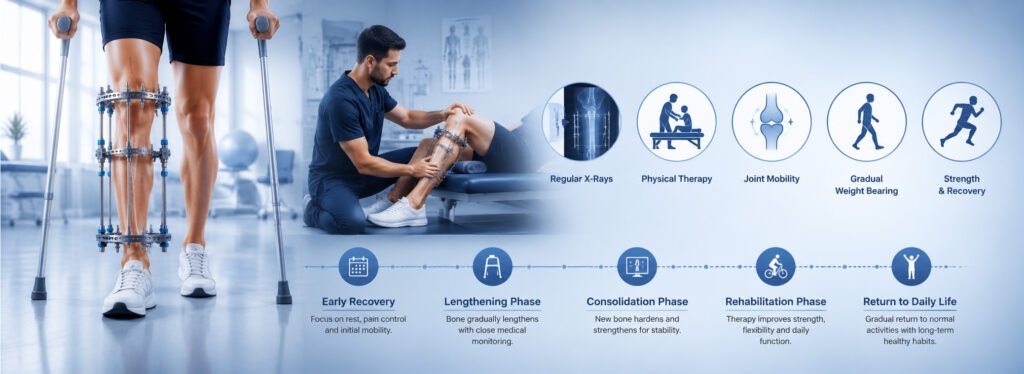
Recovery after limb lengthening height gain
Who Is a Good Candidate?
A good candidate for limb lengthening surgery should be in suitable general health, understand the recovery process, have realistic expectations, and be ready to follow a structured rehabilitation plan.
The orthopedic team may review medical history, imaging results, bone structure, mobility, lifestyle factors, and personal goals before deciding whether the patient is suitable for surgery.
Not every patient is a good candidate. The final decision should always be made by an experienced orthopedic specialist after a detailed consultation.
Planning Your Limb Lengthening Journey in Turkey
International patients considering limb lengthening surgery in Turkey should plan the process carefully. This includes medical consultation, hospital selection, surgical method comparison, accommodation, transportation, rehabilitation, and follow-up appointments.
Carenfly helps patients communicate with trusted healthcare providers, understand available treatment options, compare important details, and organize the medical travel process in Turkey.
Related Limb Lengthening Guides
Explore more resources to better understand height gain expectations, treatment options, recovery, and planning.
-
- Limb Lengthening Surgery in Turkey
Explore the complete treatment process, surgical methods, recovery, and medical travel support.
- Limb Lengthening Surgery in Turkey
-
- Limb Lengthening Surgery Cost in Turkey
Learn about pricing factors, hospital selection, and treatment planning.
- Limb Lengthening Surgery Cost in Turkey
-
- Is Limb Lengthening Surgery Painful?
Understand pain management, rehabilitation, and recovery expectations.
- Is Limb Lengthening Surgery Painful?
-
- Internal vs External Limb Lengthening Devices
Compare modern lengthening technologies and recovery experiences.
- Internal vs External Limb Lengthening Devices
- Traveling to Turkey for Limb Lengthening Surgery
Plan your treatment journey, accommodation, and follow-up process.
Frequently Asked Questions
How much height can you gain with limb lengthening surgery?
The possible height gain depends on the patient’s bone structure, soft tissue flexibility, surgical method, recovery capacity, and surgeon’s recommendation. The safest target should always be determined after a detailed orthopedic evaluation.
Is limb lengthening only for cosmetic height increase?
No. Limb lengthening may also be used to correct limb length differences caused by congenital conditions, trauma, or other orthopedic issues. Cosmetic height increase is only one possible reason for the procedure.
Can I choose how many centimeters I want to gain?
Patients can discuss their goals with the orthopedic team, but the final treatment target should be based on medical suitability and safety. Not every goal is realistic or appropriate for every patient.
Does more height gain mean a longer recovery?
In many cases, greater lengthening may require a longer treatment and recovery process. Rehabilitation, bone healing, and follow-up care are important parts of the overall timeline.
Which method is best for height gain?
There is no single best method for every patient. Internal nails, external fixators, and combined approaches may be considered depending on the patient’s condition, treatment goals, budget, and orthopedic evaluation.
Is limb lengthening surgery safe?
Limb lengthening can be performed safely in suitable patients when planned by experienced orthopedic surgeons and supported with proper follow-up and rehabilitation. However, it is a complex procedure and patients should understand the possible risks before deciding.